A Scholarship Is More Than Paying a Fee
Behind every scholarship is a decision that can influence several years of a young person’s life.
At Project Aarohan, we see a scholarship as more than financial assistance. It is a commitment to helping a student remain in education, complete their training and move towards a future with greater choice and independence. That means our responsibility begins before the first fee is paid.
We need to understand who the student is, what they hope to achieve, what might prevent them from completing their education and whether the right support system exists around them.
That is why our scholarship selection process looks beyond marks alone.
Finding Students Through People Who Know Their Communities
Project Aarohan works with experienced nonprofit partners, including Books for All and Vidya & Child, to identify students who genuinely need financial assistance.
These organisations have established relationships with schools, students, families and local communities. Their on-the-ground knowledge gives us a more complete understanding of a student’s circumstances than an application form or report card could provide on its own.
This partnership-based approach is important to us. It allows us to verify financial need while also understanding the circumstances, commitment and potential of the young person behind the application.
From there, our selection process differs depending on the type of scholarship.
For Ninth-Grade Students, We Start With Attendance
For students entering Class 9, our principal selection criterion is deliberately simple: attendance.
Students with the highest attendance are prioritised for sponsorship of their school fees. We choose attendance because consistently showing up can tell us something important about a student’s willingness to continue learning, even when financial or personal circumstances may make doing so difficult.
We deliberately do not make academic marks the primary measure of potential. Grades can be influenced by access to resources, family responsibilities, financial circumstances and the amount of academic support available outside school. A report card therefore tells only part of a student’s story.
Attendance gives us another way of recognising commitment.
For the students selected, the support does not end with school fees. Ninth-grade scholarship recipients also participate in Project Aarohan’s mentoring programme, combining financial support with guidance designed to build confidence, direction, life skills and awareness of future possibilities.
Why Vocational Scholarships Need a Different Approach
Vocational scholarships require a more detailed selection process because choosing a vocational course is both a personal and financial commitment.
Before sponsoring a student, we want to understand why they have chosen a particular course, whether it suits their interests and abilities, and whether the qualification can realistically help them move towards employment, financial independence or a sustainable livelihood.
For this reason, we speak in detail with both the student and their family before making a decision.
The purpose is not to ask a young person to map out their entire life before receiving support. Few teenagers or young adults can do that. Instead, we want to understand whether there is genuine interest, readiness to commit and a growing sense of direction.
Understanding What the Student Wants
During our conversations, we explore what the student hopes to do in the future and why a particular vocational course appeals to them. We want to know whether they understand what the training involves, how they believe the qualification could help them progress and whether they are prepared to attend regularly and complete the programme.
We also discuss possible obstacles. Are there financial or family pressures that could interrupt the course? Does the proposed career path suit the student’s interests and circumstances? Does the student understand the commitment involved?
There are no perfect answers to these questions. We are looking for something more important: evidence that the student understands the opportunity and wants to take responsibility for it.
Family Support Matters Too
A student may be highly motivated, but completing a course can be difficult without encouragement and stability at home.
That is why our vocational-scholarship process includes conversations with parents or guardians. We explain the time, attendance and commitment the programme will require and try to understand whether the family is prepared to support the student until the training is complete.
We also discuss circumstances that could interrupt their education. These pressures can take different forms for different students, which is why open conversations with families are an important part of the process.
Our objective is not to judge a family’s circumstances. It is to understand them and determine whether the student will have a realistic opportunity to complete the education for which the scholarship is being provided.
Protecting a Girl’s Opportunity to Build Her Future
For female students, one of the issues we discuss specifically is whether the family is committed to allowing the student to complete her training and pursue a career afterwards.
In circumstances where there may be plans for an early marriage that could interrupt her education, we have an honest conversation with the family about what accepting the scholarship means. The purpose of the scholarship is to create an opportunity that the student will genuinely be able to use.
Before committing funds, we seek assurance that the student will be supported in completing her training and pursuing the career for which she is preparing.
This is not about penalising a girl for decisions that may not be hers. It is about advocating for her opportunity to complete what she has started and ensuring that her education and career aspirations are treated as priorities.
Ultimately, we want the opportunity created by the scholarship to belong to her—not just at enrolment, but through completion and into the next stage of her life.
Boys Can Face Different Pressures
Male students may face a different set of expectations. Some may be under pressure to begin earning immediately, join a family business or leave training before completing their qualification.
These pressures can be very real, particularly when a family needs additional income. But leaving a vocational programme midway can also mean losing the opportunity to develop skills that could lead to stronger earning potential in the future.
We therefore speak openly with the student and family about these expectations. Wherever possible, we seek a shared commitment that short-term pressures will not unnecessarily prevent the student from completing the programme.
The principle is the same for every student: a scholarship should create a pathway forward, not simply an opportunity to enrol.
What We Look For in a Vocational Scholarship Candidate
There is no single score that determines whether a student receives a vocational scholarship. Instead, we consider several factors together:
- Demonstrated financial need.
- Genuine interest in the chosen vocation.
- Understanding of the course and possible career path.
- Willingness to attend regularly and complete the training.
- Realistic employment or livelihood prospects.
- Support from parents or guardians.
- Potential barriers that could interrupt the course.
- The student’s readiness to take responsibility for the opportunity.
Looking at these factors together gives us a fuller picture of the student’s circumstances and potential.
Potential Cannot Always Be Found on a Report Card
Academic performance is only one part of a student’s story.
A young person may have average marks but extraordinary determination. Another may have had limited access to academic support. Some students balance school with responsibilities at home, while others may simply not yet have encountered the guidance or opportunity that allows their abilities to emerge.
That is why Project Aarohan looks at commitment, attendance, aspirations, personal circumstances and family support alongside academic performance.
We are not simply asking, “How well has this student performed so far?”
We are also asking, “What might this student be capable of with the right opportunity and support?”
 From Selection to Support
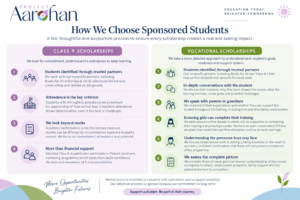
Our scholarship process can be summarised in a few clear steps.
Step 1: Students are identified
Our nonprofit partners help identify students with genuine financial need using their established relationships with schools, families and communities.
Step 2: The appropriate criteria are applied
For Class 9 scholarships, attendance is the principal selection criterion. Vocational candidates undergo a more detailed assessment.
Step 3: We speak with vocational candidates
We discuss their interests, chosen course, career aspirations, readiness and potential obstacles to completion.
Step 4: We involve the family
Parents or guardians are included in the conversation so that expectations are clear and the student has support to complete the programme.
Step 5: The scholarship begins
Selected students receive financial assistance towards their education or training.
Step 6: Support goes beyond funding
Class 9 scholarship students also participate in Project Aarohan’s mentoring programme, helping connect educational access with confidence, guidance and greater awareness of future possibilities.
Why This Process Matters to Donors
Every scholarship is also an act of trust from a donor.
When someone sponsors a student’s education through Project Aarohan, they are trusting us to identify a young person who needs the opportunity and to use that contribution thoughtfully.
Our selection process helps us honour that responsibility.
Class 9 scholarships use a clear attendance-based criterion. Vocational scholarships require a deeper assessment because they represent a specific career pathway and require significant commitment from both the student and their family.
In both cases, the goal goes beyond enrolment.
We want to give students the best possible chance of completing the opportunity their scholarship creates.
Behind Every Scholarship Is a Future Still Being Built
Behind every application is a student with aspirations, challenges and potential that may not yet be visible on paper.
Our selection process is careful because our commitment is long-term. We do not simply ask whether a student can enrol in a programme. We ask whether the right financial support, family environment and guidance can help that student complete it and move forward.
Because a scholarship should do more than pay a fee.
It should give a young person the opportunity to keep showing up, keep learning and keep building towards a future of greater confidence, capability and independence.
Sponsor a student through Project Aarohan and help turn potential into possibility.
Frequently Asked Questions
How does Project Aarohan identify students for scholarships?
Project Aarohan works with experienced nonprofit partners, including Books for All and Vidya & Child, who have established relationships with schools, students, families and communities. Their local knowledge helps identify students with genuine financial need and provides context beyond what can be understood from an application form alone.
How are Class 9 scholarship students selected?
For Class 9 scholarships, attendance is the principal selection criterion. Students with the highest attendance are prioritised for school-fee sponsorship because consistent attendance demonstrates commitment to continuing their education.
Do students need high marks to receive a Project Aarohan scholarship?
No. Academic marks are not the primary basis for selection. Project Aarohan recognises that grades can be influenced by financial circumstances, family responsibilities, access to resources and other factors. Depending on the scholarship, we consider attendance, commitment, aspirations, financial need, personal circumstances and family support.
What do Class 9 scholarship recipients receive besides financial assistance?
Selected Class 9 students receive support towards their school fees and also participate in Project Aarohan’s mentoring programme. The mentoring component is designed to help students build confidence, direction, life skills and greater awareness of future educational and career possibilities.
How are students selected for vocational scholarships?
Vocational candidates go through a more detailed assessment. Project Aarohan speaks with the student about their interests, chosen course, career goals, willingness to complete the training and possible obstacles. Parents or guardians are also involved so that the student’s support system and family expectations can be understood.
Why does Project Aarohan speak with parents or guardians?
Family circumstances can significantly affect whether a student is able to complete their education or vocational training. Conversations with parents or guardians help establish expectations around attendance, time commitment and completion, while identifying pressures that could interrupt the student’s education.
How does Project Aarohan support female vocational students?
Project Aarohan seeks assurance that female students will be supported in completing their training and pursuing the career for which they are preparing. Where circumstances such as an early marriage could interrupt education, the foundation discusses this openly with the family so that the student’s education and career aspirations are treated as priorities.
What does Project Aarohan look for in a vocational scholarship candidate?
The assessment considers financial need, genuine interest in the chosen vocation, understanding of the course, willingness to complete the training, employment or livelihood prospects, family support, potential barriers to completion and the student’s readiness to take responsibility for the opportunity.
Why are the selection processes different for school and vocational scholarships?
The two scholarships serve different purposes. Class 9 sponsorship helps students remain in school and therefore uses attendance as a clear indicator of commitment. Vocational training involves choosing a specific career pathway, so it requires a deeper assessment of the student’s interests, goals, readiness, family support and likelihood of completing the programme.
Can I sponsor a student through Project Aarohan?
Project Aarohan’s scholarship initiatives allow supporters to contribute towards students’ education and training. The aim is not simply to fund enrolment, but to help students remain in education, complete their opportunity and move towards greater confidence, capability and independence.